Is Plaque in Your Arteries Really Just Too Much Cholesterol?
11 November 2026 · Elwin Robinson
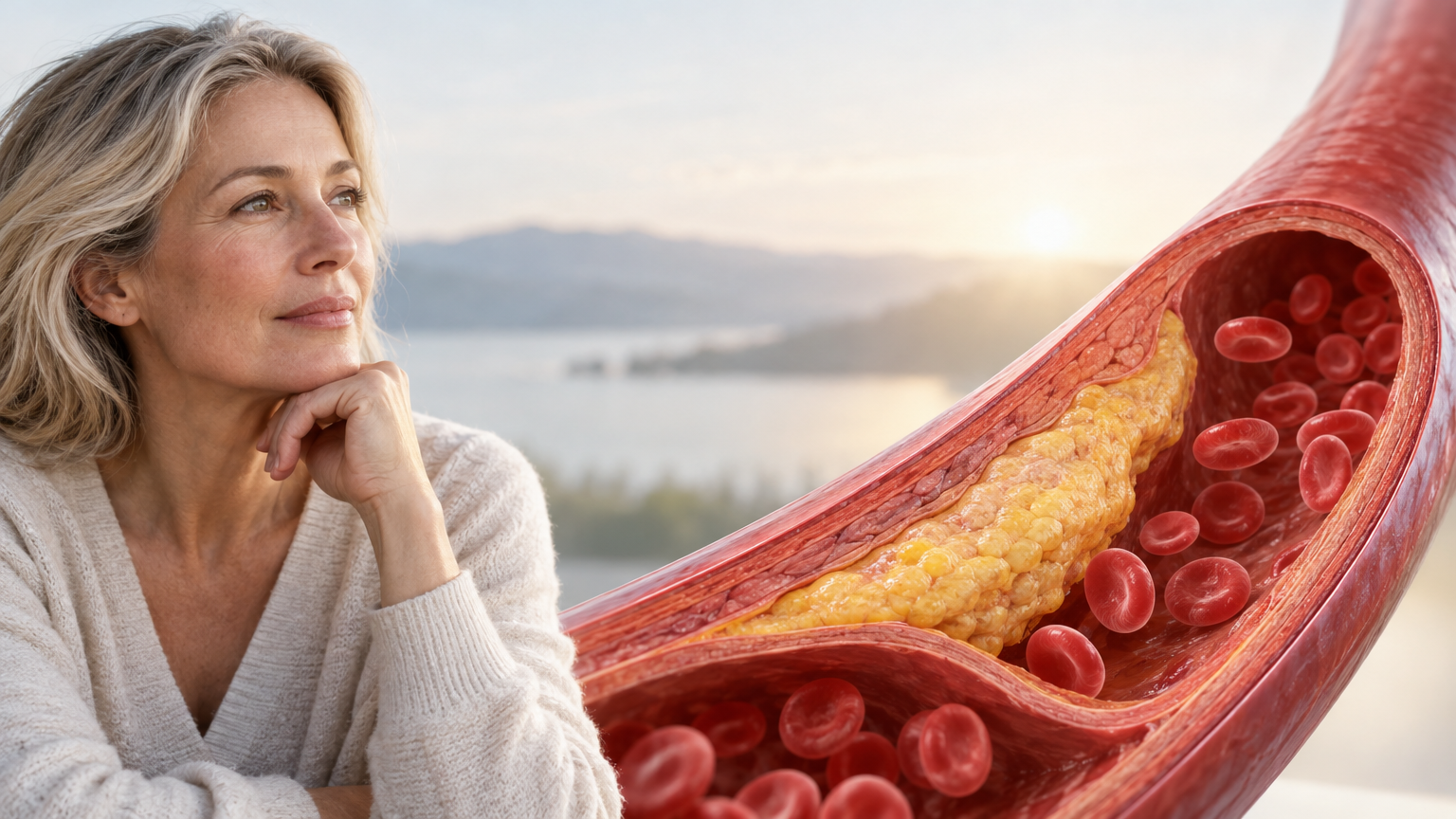
Is high cholesterol slowly clogging your arteries?
That's the picture most of us have been given. The usual answer is that the problem is cholesterol, and the plaque that builds up on the inside of your arteries. That answer gets some things right, too. Plaque is mainly made of cholesterol and calcium, and it can build up into a blockage that's genuinely dangerous.
Heart disease is the number one or number two killer in most countries, so if you're keeping an eye on your cholesterol, or a parent's, it makes sense to want to understand this. But the people giving the usual answer don't ask the obvious next question. Why would your body let that plaque build up in the first place?
My theory is that plaque is potentially your body protecting itself: something is damaging the inner wall of the artery, and plaque is a patch over the damage, a bit like a band-aid. It may even be a protective layer your body lets build up, to some degree, to shield the wall from more of whatever is doing the damage. I'd say toxins in the blood are a significant factor in that damage, though they're not the whole picture.
In this article, I'll go through how I think the patch gets built, what might be damaging your artery walls in the first place, and what this means for how you look at your own cholesterol.
How your body patches a damaged artery
When you cut your finger, it bleeds for a bit and then stops, because your body quickly forms platelets into a clot that seals the cut. I think the same thing happens on the inside of your arteries. If something damages the wall, even a micro tear too small to see, platelets gather at the spot, and a protein called fibrin forms a sticky mesh over them that holds the patch together, a kind of scar tissue.
If the damage keeps happening, your body has a reason to go further. From its point of view, something in the blood keeps causing these tears, so it starts protecting the lining of the artery itself. That's when it lays down a protective layer of cholesterol over the area, and eventually calcium as well. Calcium is the most alkaline mineral in the body, and my understanding is that your body pulls more of it into the arteries to try to neutralize acidity, so whatever is there is less corrosive.
It's a bit like what you'd do with a cut on your skin. You'd put some salve on it and cover it with a band-aid, so that the next time you bump it, the wound doesn't open straight back up.
Why your body might choose plaque
This takes a shift in how you think about your body. The usual assumption is that the body just makes mistakes, and plaque building up is one of them. I come at it from the other direction. I'd say your body wants to be healthy, so when it does something that looks harmful, like letting plaque build up on your artery walls, it's doing it for a reason, and I think the reason is protection.
Picture the choice your body is facing. If something in your blood is corrosive enough to eat a hole in an artery wall, you could easily die of internal bleeding. The alternative is to patch the spot and let plaque build up over a few decades, which could kill you much later if nothing is done about it. If those were my only two options, I'd probably make the same choice.
That doesn't make plaque harmless. Imagine you cut your finger, put a band-aid on it and forgot to take it off, then cut the same spot again and put another band-aid on top, and kept on doing that. The band-aids would pile up. Inside an artery, that kind of pile-up means the artery gets more and more blocked, and eventually part of the pile-up can break off and block it completely. That's when it becomes life-threatening.
My understanding is that your body also has a cleanup job, which is clearing away any excess of that build-up. When your body is struggling in general, from things like the modern diet, a lack of sleep, too much stress, too few nutrients, too many toxins and too little sunlight, it keeps doing the emergency patching but stops doing the cleanup. That's how a protective layer can end up thick enough to restrict your blood flow.
What could be damaging your artery walls?
There are a few reasons your body may be building up plaque, and I'd say they all come down to protection of one kind or another. Perhaps it's protecting against a breakdown of the endothelium, the protective layer lining the inside of your arteries. Perhaps it's protecting against a breakdown caused by a lack of the building blocks the wall needs, which is what I mean by a nutritional deficiency. Or perhaps it's protecting against an excess of something toxic.
When I say toxic, I mean something specific: things in your blood that are corrosive to the lining of your blood vessels, corrosive in the literal sense that they can break it. On the toxic side, these are the candidate toxins I'd look at:
- Excess sugar. There's definitely a connection between type 2 diabetes, insulin resistance, metabolic disease and cardiovascular health.
- Heavy metals. Lead and mercury are two examples.
- Pesticides and PCBs. These can build up in your body too.
- Endotoxin. It's a toxin made by harmful organisms, and in us it most likely comes from the digestive tract.
These get into your blood in more ways than you might expect. A lot of what goes on your skin gets into your bloodstream, and that includes skin products and cleaning products. You breathe things in, like the lead everyone breathed before it was banned from gasoline, or the toxins that molds and bacteria make. And then there's the water you drink and the food you eat.
I also think toxins help explain why this kind of damage is so much more common now than it used to be. People today take far fewer physical knocks than they did a couple of hundred years ago, and get far fewer burns, so injuries like those can't account for it. What we're exposed to far more of is toxins, and I'd say they could be corrosive enough to cause those tiny tears.
I can't tell you which of these, if any, applies to you. That depends on you, and it's something you find out by testing, which I'll come back to at the end.
Chronic infection: how gut toxins can reach your arteries
Endotoxin is the candidate on that list that needs the most explaining. Your body is adapted to deal with a certain amount of it. Food poisoning is what happens when the organisms making it multiply way too fast, and a lot of what makes you so sick is an excess of endotoxin and similar toxins. But there's also chronic infection, which can go on for months, years or even decades. It might rarely or never flare up badly enough to feel acute, but it's ongoing, and it's constantly leaking toxins into your system.
This is how I think that could reach your arteries. Endotoxin increases intestinal permeability, which means it makes the holes in your intestinal lining bigger, so more can get through from your intestines into your bloodstream. From there it goes to your liver. If your liver is overwhelmed, it goes on into your general circulation, where it puts a strain on your cardiovascular system and can do real damage to the walls of your arteries. In my view, plaque is potentially your body's way of repairing that damage and shielding the wall from more of it.
This is where two of what I call the seven root causes of all chronic disease meet: toxicity and excess, and chronic infections. They feed each other. Toxicity weakens the terrain, meaning the internal environment of your body, and a weakened terrain invites infection. The infection then produces its own toxins, which weaken the terrain further, and the cycle gets harder to break the longer it runs.
What this means for your cholesterol number
None of this means you should ignore your cholesterol. High cholesterol is correlated with heart disease, and I'd say that correlation is fairly clear, even if whether it actually causes heart disease is more open to question. When something is correlated with a thing that can kill you, it's worth paying attention to, and it may well be a problem.
The way I see it, high cholesterol is a sign of a problem that can cause cardiovascular disease, and not necessarily the cause itself. Plaque is also more than cholesterol. The fibrin mesh I mentioned holds the cholesterol, the calcium deposits and the platelets in place, so I'd pay attention to all of it and not only your cholesterol number.
There's another reason your cholesterol might be high. Your body uses cholesterol to package toxins into bile, which is one of the main ways it gets them out of your body, and more toxins means your body makes more cholesterol to handle them. If your bile is sluggish and those toxins are backing up, your cholesterol can rise because your body is trying to deal with a toxic burden it can't clear. One sign I'd look for is high cholesterol alongside raised liver markers, especially one called GGT. That combination may be a sign your liver is overwhelmed with toxins, rather than a sign you're eating too much fat.
Whether to bring your cholesterol down with a drug is a conversation to have with your doctor, and I'm not telling you to ignore your doctor's advice about cholesterol. Please don't stop or change any medication without talking to them first. What I'd add is one more question to bring to that conversation: why is your cholesterol high in the first place?
How to find out what's true for you
Everything above is a list of candidates. I'm not saying any one of them is what's going on in your arteries, and which ones matter depends on you. The only way I know to find out is to test, because without testing, everything else is guesswork.
I learned that the hard way. I spent fifteen years trying to detox my body with fasting, juicing and raw food, and when I finally tested my blood for heavy metals, my lead came back at 27 micrograms per deciliter. The level below which you're considered safe is three, so I was at nine times that, and more toxic than most people who'd never done a single cleanse.
If you want to look into the candidates in this article, these are the tests I'd start with:
- Heavy metals. Blood testing is the most accurate measure of what's circulating in your body right now.
- Your liver. Ask your doctor for a liver panel that includes GGT and bilirubin fractionation, not just ALT and AST.
- Blood sugar. Ask for fasting insulin. It's the single most predictive metabolic marker, and most doctors never order it. If yours is above 10 μIU/mL, you have early insulin resistance, whatever your glucose says.
- Gut infections. Ask for a comprehensive stool analysis that includes markers for dysbiosis (an imbalance in your gut's microbial community), parasites and digestive function. A standard stool test misses a significant proportion of parasites.
Start with what's easiest to control, which is what you eat and drink and what you put on your skin. What you breathe is harder to control, though an air purifier indoors helps. And please don't panic about all this. I'd say the stress of all that worry is probably worse than the poison.
If you're already being treated for your heart or your cholesterol, keep working with your doctor, and consult your doctor before you change anything. Plaque can still kill you, even if it started out as your body protecting itself. This article is educational and not medical advice.
I wrote The Rejuvenate Blueprint to help you figure out what's holding you back and how to resolve it. It's a seven-book series, one book for each of the seven root causes of all chronic disease, including toxicity and chronic infections. You can find out about it and register at rejuvenateblueprint.com.